
Fleet Operations
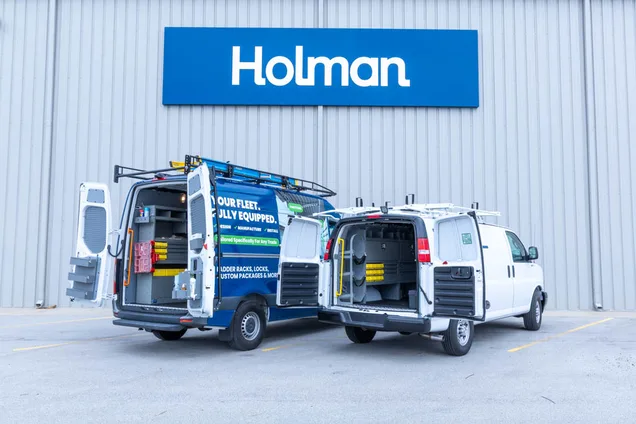
Open the back doors of three vans in most growing fleets and you'll find three different worlds: one meticulously organized, one improvised, one chaos. Every vehicle got upfitted — or not — whenever it joined the fleet, by whoever was available, with whatever was on hand. It works, barely, until the day a driver swaps vehicles and can't find a screwdriver. Fleet upfitting standardization is the fix: one proven layout, repeated across every vehicle. This guide from our Omaha team explains why that consistency pays off operationally, and how to get there without disrupting your fleet. Ready to talk specifics? Request a fleet consultation.
Standardizing a fleet upfit means defining one deliberate equipment layout — shelving arrangement, bin locations, rack placement, labeling — and installing it identically in every vehicle that plays the same role. The plumber's van in Papillion matches the plumber's van in Bellevue, down to which drawer holds the fittings.
Standardization is not one-size-fits-all. A fleet can run several standards at once, as long as each role's vehicles match each other:
What disappears is the accidental variation: five vans doing the same job five different ways, for no reason anyone can remember.
This is the core of the fleet upfitting programs we build at Revolution Upfitting, working with fleet-focused partners like Holman. You can see how we structure those programs on our fleet upfitting service page.
A technician who reaches for the same part in the same drawer hundreds of times stops thinking about it — the van becomes an extension of their hands. In a standardized fleet, that muscle memory transfers to every vehicle:
Unstandardized fleets quietly pay for the opposite: every vehicle swap costs a driver days of fumbling through an unfamiliar layout.
Ask any operations manager where time disappears during a new hire's first weeks, and vehicle orientation ranks high. Standardization shrinks it:
For fleets in a hiring market, this matters more than it first appears. The faster a new driver becomes independently productive, the sooner the vehicle they drive earns its keep.
Upfit equipment is working gear — shelves take hits, drawer slides wear, bins crack. A standardized fleet makes caring for that equipment dramatically simpler:
Modular platforms make this durable. Systems built on modular shelving — the approach we detail in our guide to choosing a van shelving system — let the standard evolve without abandoning the equipment already in service.
Customers read your vehicles. A tech who opens organized, matching doors at the jobsite signals a company that has its act together — and the impression compounds across every vehicle a customer sees around town.
Image is also an internal force. Crews treat an organized vehicle with more care than a chaotic one, and a company-wide standard communicates that the tools of the job are taken seriously. It's the same logic that leads businesses to brand their fleets visually — a specialty of our sister company, Revolution Wraps, and part of the story you can read on our about page. The wrap makes the promise; the upfit keeps it every time the doors open.
Standardization sounds expensive until you realize it doesn't have to happen all at once. The rollouts we see succeed follow a pattern:
Our team manages this process end to end — design, template build, documentation, and repeat installs — as part of our vehicle upfitting services. And if you're weighing which questions to ask an upfitter first, our frequently asked questions page is a useful companion to this guide.

© Red Barn Media Group 2026