
Standardized Upfit Programs for Multi-Vehicle Operations
Fleet Vehicle Upfitting Programs in Omaha & Lincoln, NE

Request a fleet upfitting consultation Put your fleet's needs in front of us
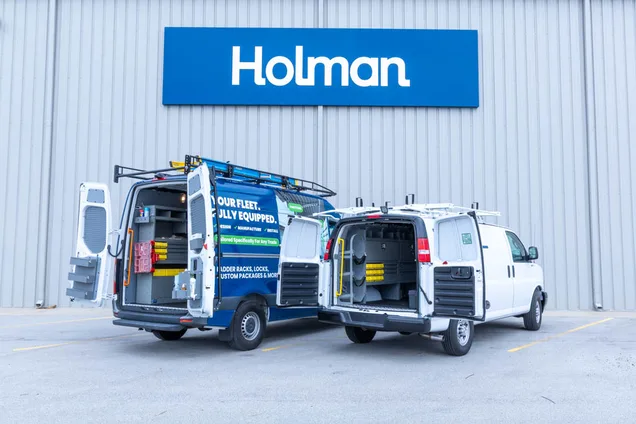
Two matching upfitted work vans from a standardized fleet program

When you run one work vehicle, an upfit is a project. When you run many, it is a program — and programs live or die on consistency. We build fleet upfitting programs for operations in Omaha, Lincoln, and across Nebraska: one standardized specification, applied vehicle after vehicle, supported by our Holman fleet partnership. Your drivers find the same tool in the same place in every unit, your managers order the same proven build every time, and your fleet spends its time producing instead of improvising. One relationship covers the entire lineup. Request a fleet upfitting consultation or put your fleet's needs in front of us.

The Case for Running One Spec Across Every Vehicle

Fleet managers do not buy shelving — they buy predictability. A standardized upfit program turns a collection of vehicles into a system:

Consistency That Compounds

One documented spec means every vehicle is loaded the same way, stocked the same way, and audited the same way. The benefits stack quietly: fewer misplaced tools, faster restocks, and inventory counts that take minutes because every unit matches the standard. Multiply that across every vehicle and every week, and standardization becomes one of the most reliable efficiencies a fleet can add.

Drivers Who Never Re-Learn a Vehicle

When any driver can step into any unit and know exactly where everything lives, vehicle swaps stop costing productivity. Seasonal help, route changes, and loaner units all get easier when the truck itself never surprises anyone. Familiarity is a real operational asset: it shortens searches, reduces mistakes, and makes cross-crew coverage painless. The layout becomes company knowledge instead of personal habit.

A Fleet-Focused Product Partnership

Our Holman fleet partnership connects your program to equipment and systems built specifically for commercial fleet duty. You get fleet-proven products specified once and repeated accurately, instead of a different solution improvised for each vehicle. That supply-side depth matters most on reorders, when consistency depends on the vendor as much as the installer.

Uptime Is the Whole Point

A work vehicle only earns when it is on the road, so the program is planned around your operation: installs staged in phases, vehicles rotated through the shop in coordination with your schedule, and the rest of the fleet working while each batch is built. Uptime is designed into the plan, not apologized for after.

Documented Specs, Repeatable Builds

Every configuration is recorded — products, placements, mounting details — so the build does not live in anyone's memory. Order three vehicles next year and they come out identical to the ones running today. If a spec only lives in memory, it is not a standard — ours live on paper.

Family-Owned Accountability at Fleet Scale

A fleet program is a long relationship, and you deserve a partner whose owners pick up the phone for it. As a family-owned Nebraska shop, we carry that accountability across every vehicle in the program — our story explains why that matters to us. We would rather keep a fleet client for the long term than win a single season.
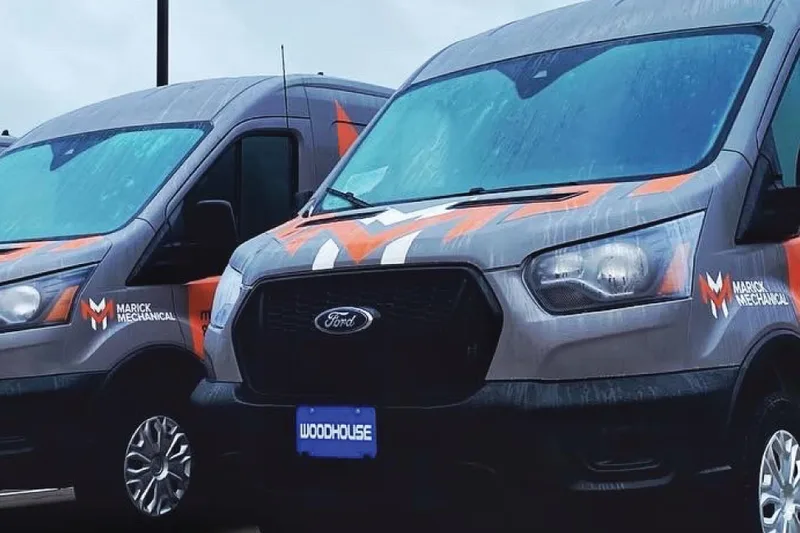
A row of matching wrapped fleet vans upfitted to one standard spec

Put Your Fleet Roster in Front of Our Team

Send us the basics through the quote form: how many vehicles, what types, what your crews carry, and what is not working today. That is enough to open a real conversation about a standardized program. Fleet specs typically draw on our full catalog of builds — van shelving systems for organized cargo areas, vehicle partitions for driver protection, and ladder racks for crews hauling material overhead. If a vehicle list or existing spec sheet exists, attach it — the fuller the picture, the sharper our first recommendations. We respond with a program outline you can circulate internally.

Request a fleet upfitting consultation

How We Roll Out a Fleet Upfit Program

A fleet program is engineered as a sequence, not a stack of individual jobs. Each phase exists to protect the two things fleets care about most: consistency and uptime.

1

Fleet-Wide Needs Assessment

We start by studying the whole operation — every vehicle class, every role, every complaint your drivers already have. Good programs are built on what crews actually do, not what an org chart assumes.

Inventory the fleet by vehicle type, role, and current upfit condition

Interview managers and drivers about what works and what wastes time

Identify which of our vehicle upfitting services each vehicle class actually needs

Document cargo, tooling, and securement requirements per role

Define the operational goals the program will be measured against

Note which vehicles are due for replacement so the spec anticipates the next cycle

2

Standardized Spec Design

The assessment becomes a written specification — the single source of truth for every build that follows, dry by design, because dry documents build identical trucks. The reasoning behind this approach is laid out in our article on why fleet standardization pays off.

Design one configuration per vehicle class, engineered around its role

Specify products, placements, and mounting details down to the component

Balance driver workflow, payload, and safety in each layout

Review the spec with your team and revise until it earns sign-off

Lock the approved spec as the program standard

Standardize components and placements so reorders never drift from the baseline

3

Pilot Vehicle Build and Sign-Off

Before the fleet commits, one vehicle proves the spec in the real world. It is far easier to change a spec once than to change a fleet twice.

Build the first vehicle of each class exactly to the written spec

Put the pilot into service with your crews and gather their feedback

Adjust the spec where real use exposes improvements

Confirm the final configuration with your decision-makers

Update the program documents so every later build matches the refined standard

Verify the pilot against the operational goals defined in the assessment

4

Phased Installation Across the Fleet

With the spec proven, the fleet moves through the shop in coordinated waves designed around your operation. The rhythm of the rollout matters as much as the builds themselves.

Schedule vehicles in batches sized to keep your routes covered

Build each unit to the locked spec with the same products and placements

Inspect every vehicle against the standard before release

Coordinate handback so returning units flow straight into service

Track progress vehicle by vehicle until the program is complete

Keep your managers informed with progress updates as each batch completes

5

Documentation and Program Handoff

The program ends with a paper trail, not a handshake — because a fleet spec is only valuable if it outlives the project. Handoff is when the program becomes fully yours.

Deliver complete spec records: products, configurations, and mounting details per vehicle class

Provide product documentation and details on how our warranty-backed coverage works for every build

Establish the reorder path for adding identical builds as the fleet grows

Review care guidelines that keep installed equipment in service

Leave your team with everything needed to run, audit, and expand the program

Close out with a program review against the goals set at the beginning

Fleet Upfitting Questions from Omaha & Lincoln Operations Managers

It is a written configuration for each vehicle class in your fleet: the exact shelving, partition, rack, and storage components, where each mounts, and how everything is installed. It also records the reasoning — what each role carries and why the layout serves it. That document becomes the standard every current and future build is measured against. Nothing about the build is left to interpretation on the shop floor.

Our Holman partnership gives your program access to equipment engineered for commercial fleet duty and a product ecosystem built around repeatability. For you, that means specs built on fleet-proven components that can be ordered and installed consistently as your fleet grows, rather than one-off solutions pieced together vehicle by vehicle. It is a partnership built for fleet work, which is exactly how we apply it.

Yes — mixed fleets are normal, and the program handles them by defining one standard per vehicle class. Your vans share a spec, your pickups share a spec, and your box trucks share a spec, all designed to work together operationally so crews move between vehicle types without relearning where anything lives. One partner, one standard, every vehicle class in the operation.

Instead of pulling the whole fleet at once, we build in batches coordinated with your dispatch schedule. A portion of the fleet is in the shop while the rest keeps running routes, and finished vehicles return to service as the next batch rotates in. The program advances continuously without shutting down your operation. Batch sizes are set with your dispatcher, not imposed on them.

Because every search for a tool is paid time. When all vehicles in a class share one layout, a driver in a borrowed or replacement unit is instantly productive — no hunting, no guessing, no leaving gear behind. Familiarity also improves accountability, since a missing item is obvious the moment a standardized shelf sits empty. New hires learn one layout and instantly know the whole fleet.

That is one of the main reasons the spec is documented. When you add vehicles, we build them to the locked standard — same components, same placements, same quality checks — so unit twenty matches unit one. Your fleet stays uniform no matter when each vehicle entered service. That repeatability also protects the program's value as older vehicles cycle out and replacements arrive.

You get the complete program record: per-class specifications, product lists, configuration and mounting details, product documentation, and the reorder path for future builds. It is everything a new fleet manager would need to audit, maintain, or expand the program without a single detail living only in someone's head. We treat documentation as a deliverable, and it belongs to you.

Yes — most fleet specs are combinations. A service van class might carry a partition behind the cab, shelving on both walls, and a rack overhead, all specified as one integrated build so mounting points, clearances, and load paths cooperate. The spec treats the vehicle as one system, not a pile of separate accessories. Specifying everything together is how conflicts get caught on paper instead of in steel.

Standardization removes the improvisation that causes incidents. Every vehicle gets engineered securement instead of loose cargo, partitions where roles call for them, and consistent load placement drivers can trust. Because every unit matches the standard, safety inspections are faster and gaps are easier to spot before they become injuries. A fleet that looks the same every morning is easier to keep safe.

Growth is exactly what the program is built for. The documented spec makes each added vehicle a repeat order rather than a new project, and phased scheduling flexes as your fleet expands. Whether you are adding two vehicles or standing up a new division, talk with our team about folding growth into the program. Standardization should never be the thing that slows growth down.

Fleet Upfitting for Omaha, Lincoln, and Across Nebraska

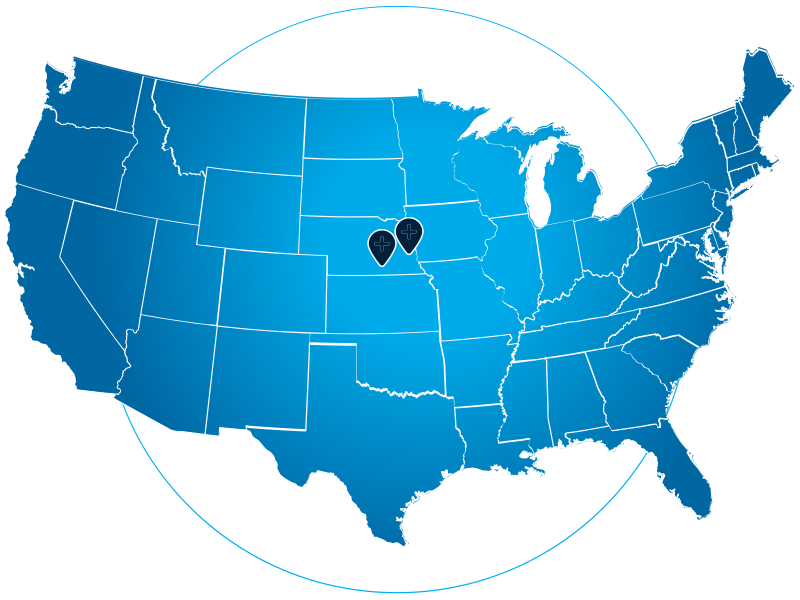
Fleet programs run out of our Omaha facility and serve operations across the region — every program held to the same documented standard:
  • Omaha — fleet operations throughout the metro
  • Lincoln — capital-area fleets that want one consistent standard across every unit
  • Papillion — service fleets working Sarpy County
  • La Vista — companies based along the metro's commercial corridors
  • Bellevue — fleets covering the southeast metro
  • Elkhorn — growing operations in the west metro
  • Bennington — northwest metro businesses
  • Nebraska City — southeast Nebraska operations
  • Grand Island — central Nebraska fleets running long daily routes
  • Kearney — programs reaching into the west
  • Kansas City, MO — regional operations with vehicles across the corridor
Fleet Upfitting for Omaha, Lincoln, and Across Nebraska Fleet Upfitting for Omaha, Lincoln, and Across Nebraska

The Building Blocks Behind Every Fleet Spec

A fleet program assembles our individual services into one standard. These are the builds most specs draw from — each available on its own, each stronger when specified fleet-wide:

Van liners

Floor, wall, and ceiling protection that keeps every cargo area in the fleet durable and easy to clean. Protection specified once, applied to every vehicle identically.

Truck bed storage

Secure drawer systems, including TruckVault units, that standardize how your pickup crews carry and protect tools. One security discipline for every pickup in the program.

Steps and running boards

Non-slip access hardware that reduces climb-in strain across tall vehicles, all day, every driver. Small hardware, large reduction in daily wear on your people.

Box truck upfitting

Full interior builds that bring your largest vehicles into the same organized standard as the rest of the fleet. No vehicle class gets left outside the program.
Standardize the Fleet, Simplify the Operation

Every fleet already has a standard — the question is whether it was designed or whether it accumulated. Vehicles upfitted one at a time, by different vendors, with different products, leave you managing a museum of one-off decisions. A fleet upfitting program replaces that with a single engineered spec: designed once, proven on a pilot vehicle, installed in phases, and documented so thoroughly that your next vehicle order is a repeat, not a reinvention. That is what turns fleet decisions from recurring headaches into a settled system. One spec, one partner, one standard your drivers can count on.

That is the work we want to earn in Omaha: not one build, but the standard your whole operation runs on. We bring the product depth of our Holman fleet partnership, the installation discipline of a shop that builds work vehicles every day, and the accountability of a family business that expects to be your upfitter for the life of the fleet. What other operators think of working with us is on our reviews page, and the general questions most managers ask first are covered in our upfitting FAQ. We measure the program's success the way you do: vehicles working, drivers productive, orders repeatable.

Start where every good program starts: with your roster, your routes, and a conversation about what consistent vehicles would change for your operation. We will map the path from where your fleet is to where it should be — one spec at a time. The fleet you run next year is being shaped now; the only question is whether it is shaped on purpose. Bring the roster, and we will bring the standard.

© Red Barn Media Group 2026