
On-Board Vehicle Power — Omaha & Lincoln, NE
Power Inverters That Put a Workshop on Wheels in Omaha & Lincoln

Request an Inverter Quote See Our Full Service Lineup
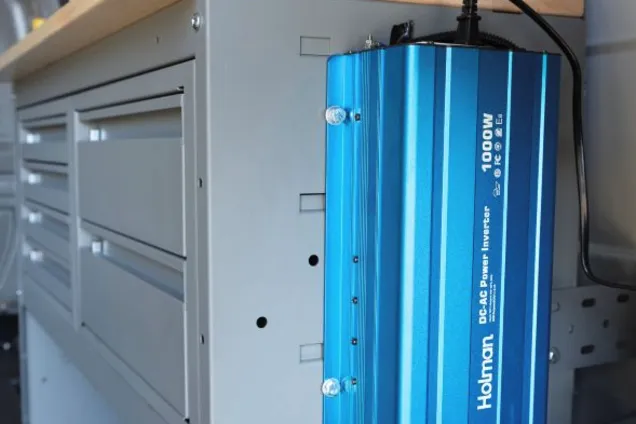
Close-up of a 1000-watt Holman power inverter mounted to the side of a van drawer cabinet

Every crew knows the ritual: hunting for an outlet, running cords across a parking lot, discovering the tool batteries died somewhere between stops. Revolution Upfitting installs vehicle power inverters for businesses across Omaha, NE and Lincoln, NE, turning work vans, pickups, and box trucks into rolling workshops that carry their own power. Tools run, chargers cycle, and the office rides in the cab — wherever the vehicle parks. Every system is professionally wired, cleanly integrated with the vehicle's electrical system, and designed around the equipment your crew actually plugs in.

Why the Job Site's Outlets Stop Mattering

On-board power changes the math of a workday: the vehicle stops being the thing that carries the work and becomes the thing that powers it. But an inverter is only as good as the wiring behind it — and unlike shelving or a rack, the quality of an electrical install is invisible until it matters. That invisible layer is where we earn our keep:

Power Designed Around Your Tools

Every build begins with what your crew plugs in — corded tools, charger banks, laptops, test equipment — and how hard they use it. The system is specified from that conversation, not pulled off a shelf as a one-size package.

Wiring Treated as Seriously as the Equipment

Cabling correctly sized for the system, routed away from heat and moving parts, secured along its full run, and protected at every circuit. The install you cannot see is the install that determines whether on-board power is an asset or a liability.

Outlets Where the Work Happens

Power belongs at the bench surface, beside the charger shelf, in the cab, or at the truck bed — wherever your workflow says. We place outlets around the way your crew works, so nobody stretches a cord through a cargo area to reach one.

The Vehicle's Electrical System Comes First

A power system that strands your crew with a dead battery has failed at its only job. We design around the vehicle's electrical capacity, integrate cleanly with the factory system, and hand off the habits that keep everything healthy.

A Family Shop Accountable for the Invisible Work

You will plug into this system every working day for years, and we are a family-owned Nebraska business you can walk back into if a question ever comes up. Our story is built on standing behind work that hides behind panels.

Part of a Complete Vehicle, Not an Accessory

Power planning happens alongside lighting, shelving, and storage, so circuits are routed once and every system has its place. The end state is a coherent mobile workshop, not a collection of add-ons competing for space.
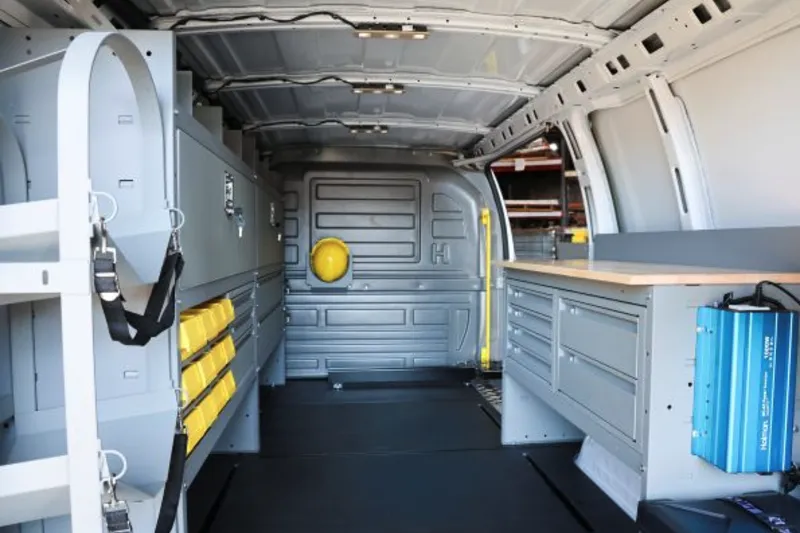
Van cargo area with a Holman drawer cabinet, workbench, and a blue power inverter mounted to its side

Tell Us What Your Crew Needs to Plug In

The perfect starting point for an inverter quote is a simple inventory: the tools, chargers, and equipment your crew wishes ran off the truck, and where they would plug each one in. Send that list through our quote form and we will design the system around it. On-board power also multiplies the value of the rest of the build — pair it with LED cargo lighting while the electrical work is already planned, dedicate a shelf on a van shelving system to a wired-in charger bank, or fold it into a complete trade package configured for your line of work. However far the project reaches, the equipment list is where the design begins.

Request an Inverter Quote

How On-Board Power Gets Engineered Into a Vehicle

An inverter install is an electrical engineering exercise before it is a wrench-turning exercise. Here is the sequence every system follows at our Omaha facility:

1

The Power Needs Conversation

We start by mapping what the system must actually support — because the equipment list drives every decision after it:

Equipment inventory — the corded tools, battery chargers, computers, and gear your crew runs

Usage patterns — what runs while driving, what runs parked, and what runs at the same time

Workflow mapping — where in and around the vehicle each piece of equipment gets used

Vehicle review — the platform's electrical system and how the vehicle spends its day

Priority ranking — the equipment that must always have power versus the nice-to-haves

Growth questions — the equipment your business is likely to add over the vehicle's life

2

System Design and Outlet Placement

Next we translate the needs list into a system layout you can review and approve:

Inverter sizing matched to your real equipment load, with honest guidance on trade-offs

Outlet locations planned at the bench, the charger shelf, the cab, or the bed — where work happens

Mounting location chosen for protection, ventilation, and access without sacrificing cargo space

Integration planned around existing or incoming shelving, lighting, and storage

Switching and controls positioned so the system is simple to run and hard to misuse

A design review with you before a single component is ordered

3

Component and Wiring Specification

With the design approved, we commit the electrical details to paper — the part of the project most installs skip:

Components specified to work together as a system, not a parts-bin assortment

Cabling sized correctly for the load and the run lengths inside your vehicle

Circuit protection planned for every leg of the system

Routing paths mapped away from heat, moisture, moving parts, and cargo strikes

The complete specification written into your quote, so you know exactly what goes in

4

Professional Installation at Our Omaha Facility

Your vehicle comes to our shop, and our own team executes the plan end to end:

The inverter mounted secure, protected, and ventilated at its planned location

Cabling routed and fastened along the mapped paths, with penetrations sealed

Connections made cleanly to the vehicle's electrical system, factory harness respected

Outlets and switching installed at the planned positions around the workflow

Coordination with any lighting, shelving, or storage going in on the same visit

Panels and trim reinstalled properly, with no evidence of the work except the outlets

5

Live Testing and Owner Orientation

We do not hand back a vehicle on faith — the system proves itself before it leaves:

The full system exercised with realistic loads, every outlet and switch verified

Charging behavior confirmed so the vehicle and the system stay healthy together

A walkthrough of operation, capacity, and the habits that protect the battery

Documentation of the installation and its components for your records

Guidance for the rest of the crew, so every driver runs the system the same way

A direct line back to our team for questions once the system is in daily service

Vehicle Inverter Questions We Field in Omaha & Lincoln

These are the questions Omaha and Lincoln businesses ask most about on-board power. Some come from crews who have never had it; most come from crews who tried a cheap install once and want it done properly this time. For general upfitting questions — quoting, vehicle prep, brands — our vehicle upfitting FAQ covers the basics.

An inverter converts the vehicle's battery power into the kind of power ordinary equipment plugs into — corded tools, battery chargers, laptops, printers, test equipment, and task lighting are the everyday examples. What a specific system supports depends on the equipment you run, which is why every build begins with a power-needs conversation rather than a one-size package.

It removes the job site's outlets from the equation. With on-board power, your crew charges batteries between stops, runs corded tools where no service exists, and handles paperwork from the front seat. The vehicle stops being mere transportation and becomes the place where work happens — which is the whole idea behind vehicle upfitting in the first place.

Because an inverter ties directly into the vehicle's electrical system, the quality of the wiring is the quality of the installation. Professional work means correctly sized cabling, secure routing away from heat and moving parts, proper circuit protection, and clean integration with the factory system. A bargain install risks the vehicle itself; ours is backed as our warranties page describes.

A properly designed system is built to prevent exactly that. We plan the installation around your vehicle's electrical capacity and your actual usage patterns, then walk through the habits that keep the battery healthy during the handoff. This is another place where professional design matters — the goal is dependable power at the site and a vehicle that starts every time.

In a protected, ventilated location chosen for your specific vehicle and layout — typically out of the cargo path, where shifting equipment cannot strike it. Mounting position is planned alongside your shelving and storage so the unit stays accessible without giving up usable space. Placement is part of the design conversation, never an afterthought.

Yes — outlet placement is one of the most valuable parts of a professional installation. We position outlets where the work actually happens: at a bench surface in the cargo area, beside the charger bank on the shelving, in the cab for office tasks, or at the bed of a pickup. You describe the workflow; we put power inside it.

Any vehicle that functions as a rolling workshop: cargo vans running service routes, pickups supporting field crews, and box trucks built out as mobile shops. If your crew has ever idled hunting for an outlet, stretched cords across a lot, or arrived with dead tool batteries, the vehicle qualifies. We design systems for all three platforms.

This is the single most popular use we build for. Drive time becomes charge time: a charger bank wired into the shelving keeps battery packs cycling while the vehicle moves, so the crew arrives at every stop with fresh power. Paired with an organized charging shelf, it quietly eliminates one of the most common reasons work stalls.

A generator is one more thing to load, fuel, maintain, and listen to — and it occupies cargo space all day for the minutes it gets used. An installed inverter rides invisibly in the vehicle, is ready the moment you park, and draws from a system you already maintain: the vehicle itself. For everyday tool and charger loads, most crews stop reaching for the generator.

Yes — mobile office power is a frequent request from contractors who write estimates, print invoices, and process paperwork in the field. An outlet in the cab or at a cargo-area work surface keeps office equipment running without hunting for a coffee shop. Tell us how your paperwork gets done, and we will put an outlet where it happens.

On-Board Power for Omaha, Lincoln, and the Surrounding Region

The farther a crew works from its home base, the more on-board power earns its place — which is why vehicles come to our Omaha shop from well outside the metro:

  • Omaha, NE — home base, where every power system is wired and load-tested
  • Lincoln, NE — crews covering the capital region with power on board
  • Papillion, NE — field crews working far beyond the reach of wall outlets
  • La Vista, NE — service vehicles minutes from our bays
  • Bellevue, NE — contractors running charger banks on daily routes
  • Elkhorn, NE — builders powering tools on new-construction sites
  • Bennington, NE — rural job sites where the truck is the only outlet around
  • Nebraska City, NE — southeast Nebraska trades working straight off the vehicle
  • Grand Island, NE — central Nebraska operations working far from the shop
  • Kearney, NE — I-80 corridor fleets that turn drive time into charge time
  • Kansas City, MO — regional companies that bring their vehicles to Omaha
On-Board Power for Omaha, Lincoln, and the Surrounding Region On-Board Power for Omaha, Lincoln, and the Surrounding Region

Everything Else a Working Vehicle Deserves

On-board power is one piece of a vehicle built for work. These services finish the job:

Box truck upfitting

complete interior builds where inverter power runs benches, chargers, and equipment inside a true mobile shop. The bigger the box, the harder on-board power works.

Fleet upfitting

put the same power spec in every vehicle you run, so any crew can plug in the same gear in the same place across the fleet. Documented once, repeated every time.

Truck bed storage

secure TruckVault drawer systems that keep the tools your inverter powers organized, protected, and locked down between uses.

Van liners

durable floor, wall, and ceiling protection that keeps the cargo area housing your electrical equipment clean, dry, and intact for the long haul.

Put On-Board Power in Your Work Vehicle in Omaha or Lincoln

Add up what chasing power actually costs an operation. Crews idling while batteries charge off someone else's outlet. A generator riding along all day — loaded, fueled, and maintained — for twenty minutes of use. Estimates written back at the office because there was nowhere to plug in a laptop. Every one of those moments is paid time producing nothing. A professionally installed vehicle power inverter retires the whole routine: the power rides with the crew, ready the moment the vehicle parks, drawn from a machine your business already owns and maintains.

The path to a quote is straightforward. Send us your equipment list through our contact form — the tools, the chargers, the office gear — and where your crew would ideally plug each one in. We will design a system around that reality, put the complete specification in writing, and wire it into your vehicle at our Omaha facility with the kind of workmanship that never needs to be looked at twice. You approve every component before it is ordered, and the system proves itself under load before the vehicle leaves. If the honest answer is that your equipment list calls for something simpler than you expected, that is exactly what we will tell you.

Power is the upgrade crews notice every single day, and it is the kind of work our reputation is built on — our customer reviews come from businesses that trusted us with theirs. One van or an entire fleet, the conversation starts the same way: tell us what you need to plug in, and where the work happens. We will design around the answer, wire it like we own the vehicle, and make sure the outlet is always right behind you.

© Red Barn Media Group 2026